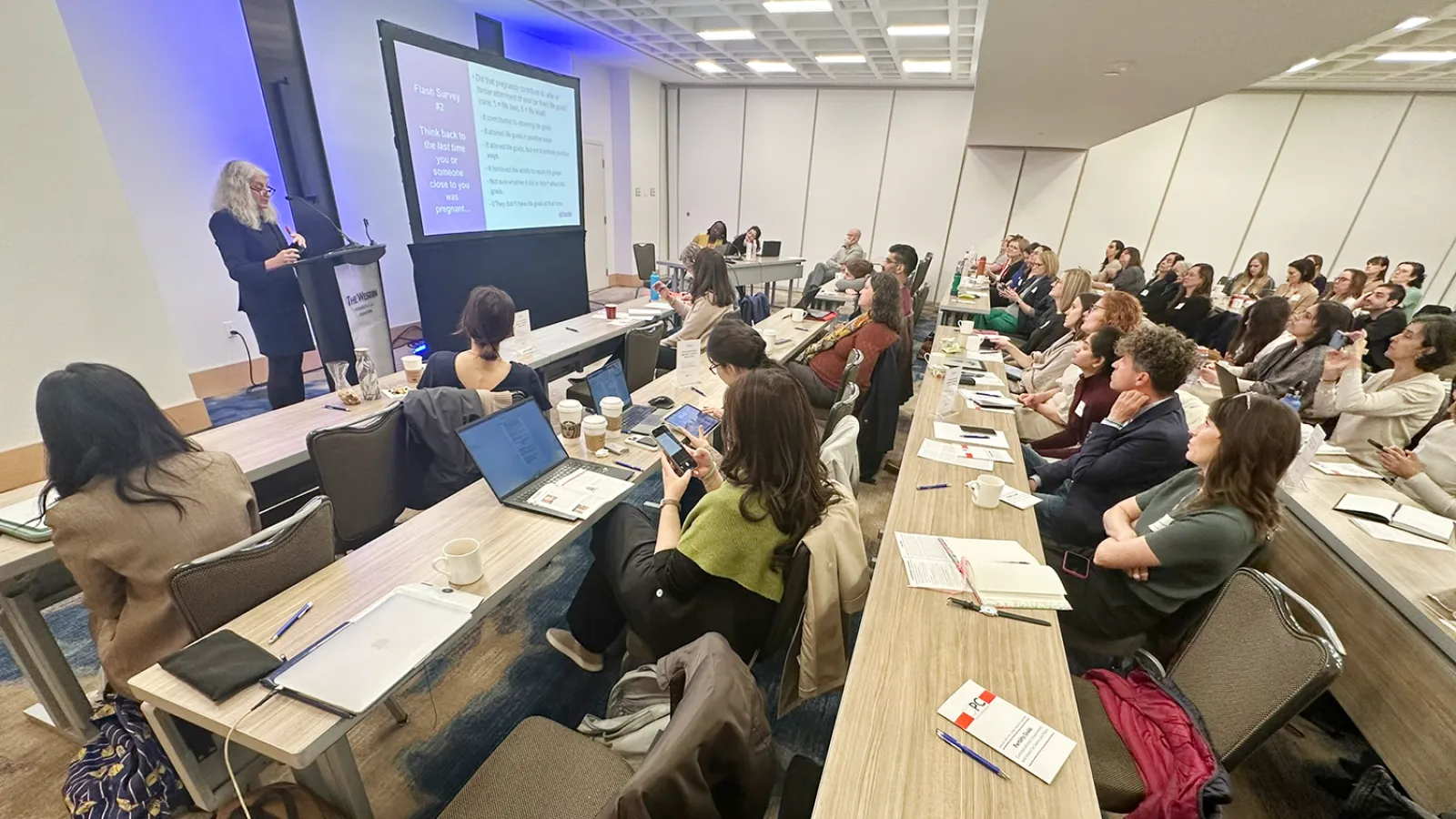
Fertility Goals Workshop Series 2025-26
Fertility Goals: Conceptualization, Measurement, and Impact for Science and Policy

Workshops sponsored by the Ohio Population Consortium
Organizers: John Casterline, Emeritus Professor, Ohio State University; Sarah Hayford, Robert T. Lazarus Professor, Ohio State University; and Wendy Manning, Dr. Howard E. and Penny Daum Aldrich Distinguished Professor, Bowling Green State University
Over the course of the twentieth century, fertility intentions, desires, preferences, and attitudes (fertility “goals”) became key constructs for demographic research on fertility. In high-fertility contexts, unwanted births and unmet need for contraception serve as a justification for intensifying family planning programs. In low-fertility contexts, desired fertility exceeds actual fertility, implying high prevalence of “unrealized fertility” and inspiring hope that appropriate policies can produce fertility rebound. In both contexts, the increasing focus in the past two decades on reproductive autonomy and reproductive justice centers women’s (and occasionally men’s) own desires and preferences as the foundational concern for policy and programmatic activity. Yet even as fertility goals have gained theoretical and policy importance, many questions remain around conceptualization and measurement of these constructs. We seek to explore the ways fertility goals have been defined and measured; how they have been used in scientific research and in policy applications; the challenges and limitations of these constructs, both theoretical and empirical; what we learn by analyzing fertility goals; and what is missed by centering individual fertility goals.
Spring 2025
The 2025 series of events included the two webinar below and a one-day in-person meeting in Washington, DC, on April 10, 2025 (in conjunction with the Population Association of America Annual Meeting).
Webinar 1: Conceptualization and Measurement of Fertility Goals
Thursday, February 27, 2025
12 – 1:30 pm, Eastern Standard Time (UTC-5)
Monika Mynarska, Institute of Psychology, Cardinal Stefan Wyszyński University in Warsaw
Corinne Rocca, Ob/Gyn and Reproductive Sciences, University of California-San Francisco
Elizabeth Sully, Guttmacher Institute
Webinar 2: What Fertility Goals Tell Us about Fertility Trends
Monday, March 24, 2025
12 – 1:30 pm, Eastern Daylight Time (UTC-4)
Éva Beaujouan and Shalini Singh, Department of Demography, University of Vienna
Karen Benjamin Guzzo, Department of Sociology, University of North Carolina-Chapel Hill
Francis Obare Onyango, Population Council
Spring 2026
The continuation of this series will include the three webinars below.
Webinar 3: Contingency and Context of Goals for Having Children
Thursday, January 29, 2026
12 – 1:30 pm, Eastern Daylight Time (UTC-5)
Even in low-fertility countries, two children continues to be the modal response to survey questions about ideal, desired, or planned family size. From these observations, demographers have concluded that the two-child family is a powerful and stable ideal motivating decisions about childbearing. Yet increasing evidence questions the way this ideal is translated into specific choices.
The “two-child family” norm is conditioned by other goals and constraints (including, but not limited to, partnership dynamics, career aspirations, and financial circumstances). Speakers in this webinar will reflect on what we know from survey data about how the ideal of the two-child family is related to other financial and family goals; how gender ideologies of work and family shape the desired number of children; and how lived experiences of family planning, pregnancy, and childbirth may shape prospective childbearing desires.
Presenters:
Julia Behrman, Department of Sociology, Northwestern University
Eunsil Oh, Department of Sociology, University of Wisconsin-Madison
Emily Mann, Department of Health Promotion, Education, and Behavior & Department of Women’s and Gender Studies, University of South Carolina
Webinar 4: The New Wave of SRH Indicators: Where Do Fertility Goals Fit In?
Thursday, February 12, 2026
12 – 1:30 pm, Eastern Daylight Time (UTC-5)
There has been a recent surge of efforts to develop new indicators of sexual and reproductive health, indicators intended to supplant the constructs “unmet need for contraception” and “demand satisfied” that have served as featured indicators during the past two decades.
The proposed indicators reflect an effort to achieve a more woman-centered approach to both SRH science and policy. Fertility goals were essential ingredients of the past indicators. Where do they fit in now? Have they been sidelined (deliberately or unintentionally)? If so, is this defensible and desirable, from both a scientific and policy perspective?
The aim of this webinar is to have an energetic exchange about these (and related) questions.
Presenters:
John Casterline, Institute for Population Research, The Ohio State University
Nurudeen Alhassan, AFIDEP, Lilongwe, Malawi
Jamaica Corker, External Research Affiliate, Center for Studies in Demography & Ecology, University of Washington
Leigh Senderowicz, Department of Gender & Women’s Studies, University of Wisconsin-Madison
Webinar 5: The Relational Context of Fertility Goals
Wednesday, March 25, 2026
11 am – 12:30 pm, Eastern Daylight Time (UTC-4)
The Ohio Population Consortium presents this fifth webinar in a series focusing on fertility goals.
Most children are born into two parent families, and romantic relationships are likely the most proximal determinants of fertility goals. Yet relatively little research is focused on the relationship context of fertility goals. A major issue is that most demographic studies are restricted to measures of relationship status and do not consider more refined measures of the relationship quality and dynamics. Further, many studies highlighting relationship indicators are based solely on heterosexual couples. Speakers in this webinar will reflect on what we know about how relationship qualities and partners form fertility goals. They will also discuss how demographic research can be expanded to consider how intimate relationships are related to fertility goals.
Presenters:
Nicole Hiekel, Research Group Leader, “Gender Inequalities and Fertility,” Max Planck Institute for Demographic Research, Rostock, Germany
Alina Pelikh, Senior Research Fellow in Demography and Deputy Research Director, Centre for Longitudinal Studies, University College, London, England
Wendy Manning, Department of Sociology, Ohio Population Consortium, Bowling Green State University, Bowling Green, Ohio