Affiliate Spotlight: Julie Gressley
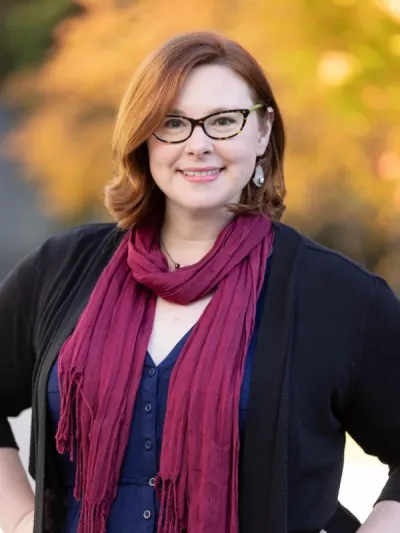
Julie Gressley is a PhD candidate graduating spring 2026 from the Department of Human Sciences/Consumer Sciences program. Her research focuses on how family arrangements and urbanicity shape postsecondary education decisions and occupational choices of young people. Family background has been viewed as a predictor of higher education and occupational outcomes, and Julie's research explores contextual pathways of how this occurs.
Julie shared her answers with the Institute for Population Research (IPR) to the following questions about her career, research interests, and the impact of her work.
Q: Which of your current projects are you most excited about?
I’m excited about work I’m doing that digs into the intergenerational transmission of educational attitudes based on the career outcomes of the parent.
Q: How have you been connected to IPR during your time here at Ohio State? What drew you to IPR initially? How do you benefit from your involvement with IPR?
I was introduced to IPR in my first year at Ohio State. IPR hosts researchers across disciplines all operating with one core commonality: demographic and population studies. I love how one common base can be used to spur research and build knowledge in so many fields. I was originally drawn to IPR for demographic studies but have learned so much more through hosted training programs, seminars, and their relationship with a broader research community.
Q: What has been the biggest impact of your work so far, or what do you hope for future impacts for your work?
My hope is that my research can provide broader insight into how individuals and families make education and career decisions, and how urbanicity influences financial decision-making and career opportunities.
Q: What are your career goals after you complete your doctorate?
I hope to direct my career toward research that supports the public, with a broader goal of creating research that can be used to improve practical knowledge and the financial decision-making of families and individuals at different segments of their life-course.
Q: How did you come to your research area?
While I grew up in a rural area, most of my career required that I live and work in urban areas. The way that people think and learn, the knowledge they have, values and beliefs, all felt dramatically different between these spheres. Professional work in regional economics demonstrated the recent transformation of employment opportunities in former manufacturing areas in less than a full generation. Economic developers in every town are trying to figure out how to draw businesses and keep their people employed and earning livable wages. Meanwhile, families try to do the best that they can for their future, but in rapidly changing environments, it’s hard for anyone to know which direction is the optimal one. My goal is to pursue research that can improve information for families so that the cause and consequence of different choices will better highlight the regional nature behind our understanding of how decisions lead to different outcomes based on geography.
Q: What motivates you to do what you do?
Following the traditional route of higher education has been considered the prescription for career success and the safe way of achieving a livable wage. Student debt and high cost of living has led many people to question whether this advice is still valid. My current work examines variation in family and population density environments to see if differences in geography and family backgrounds influence student outcomes.
Q: Do you have a research finding that you’ve been most surprised by?
I have done some research on how public statistics measure child support income and household frequency at the state level. My original goal with this work was to examine how reliability and size of child support income at the state-level relates to child outcomes and mother’s financial health. I was surprised to find that longer-term public statistics on this subject was simply not available at the state level. I was also extremely surprised by how infrequently these type of arrangements are used and the modest size of these payments, especially given that 40% of births in the U.S. are to unmarried mothers, but that nationally reported delinquent payments were over $30 billion annually — nearly double the funding for the federal block grant program Temporary Assistance for Needy Families.
Q: Have you done any community-engaged or participatory work? What was this experience like, and how did it shape your research goals or practices?
One of the first projects I worked on at Ohio State was with a team of researchers examining food security in rural areas during COVID. This research considered farmers’ markets and informal food networks, like home gardening, hunting, fishing, and foraging in an area with low food access. The prevalence of community sharing among survey respondents was initially surprising. But I also do volunteer work with Franklin County Master Gardeners and food sharing among the local gardening community is significant. This experience encourages me to consider the role of informal networks to a greater extent in future research work. It’s a much more difficult way to measure household consumption, but I think this could be a fruitful avenue with a thoughtful approach.